June 2026 Case Study: How Public Procurement became a Turning Point for Shark Conservation in Brazil, and a Model for Advancing SDG 14
Sustainable Development Goal (SDG) 14 focuses on conserving and sustainably using oceans, seas, and marine resources. While most attention is usually placed on fisheries regulation and protected areas, public procurement is one of the strongest, yet most overlooked, levers for reducing demand for threatened marine species. Public institutions (schools, hospitals, prisons, social programs) purchase enormous quantities of food. When procurement rules exclude threatened marine species, require traceability, or mandate species identification, they contribute to SDG 14 goal and targets. Brazil is now providing a rare, real-world example of how procurement can expose marine biodiversity loss, cut demand for unsustainable wildlife products, and activate regulatory change.
For decades, Brazil was the world’s largest buyer and consumer of sharks, a position that fueled both global fin markets and domestic commercialization. Sharks were rarely seen as keystone predators essential to ocean stability. Instead, they entered Brazil’s food systems as anonymous protein under the generic term cação, obscuring species identity and hiding the ecological and toxicological risks associated with their consumption.
This case study demonstrates how public procurement, one of the most powerful yet overlooked government levers, became central to dismantling this opaque trade model. Brazil’s shift now serves as a compelling example of how institutional purchasing can directly advance SDG 14 (Life Below Water).
How Shark Meat Entered Brazil’s Public Institutions
Shark meat did not circulate only through private markets. It was deeply embedded in Brazil’s food procurement for schools, hospitals, prisons, military facilities, and social welfare kitchens, often unknowingly. A breakthrough moment came in July 2025, when a Mongabay investigation revealed the true scale of this procurement: 1,012 public tenders issued since 2004 to procure more than 5,400 metric tons of shark meat across 10 Brazilian states, including Rio de Janeiro.
This discovery confirmed what activists and scientists had long suspected, that public procurement was a major structural pillar holding up the shark trade, not simply incidental demand.
Further reporting showed that in schools and prisons, shark meat was being served routinely, often mislabeled generically as “fish” or “cação.” Public institutions were unintentionally legitimizing the shark trade, sustaining high-volume commercialization, and exposing vulnerable populations, including children, to dangerous contaminants such as mercury, arsenic, cadmium, and lead.
Institutional bans on shark meat procurement
The picture became even clearer as local investigations uncovered procurement practices in individual states. Rio de Janeiro, for example, was found to have incorporated shark meat into its public school meals for years, prompting a decisive reaction: the state formally banned shark meat from all public school menus. Other institutions followed suit. Brazil’s largest public hospital, Hospital das Clínicas, announced it would no longer procure shark meat. Major catering companies such as Sodexo removed cação from their offerings. Municipalities like Santos and São Paulo issued local prohibitions, while states like Paraná implemented broader bans.
Meanwhile, civil society organizations amplified pressure through litigation, public campaigns, and data-driven advocacy. Their legal challenge led the federal court to rule that using the term cação in public procurement obstructed traceability and endangered public health. The ruling forced the federal government to implement species identification and traceability in all federal public procurement, effectively dismantling one of the shark trade’s strongest routes into institutional food systems.
Court-ordered species identification and traceability in federal procurement, and new export regulations
A federal court recognized that selling shark and ray meat under the generic term cação conceals species identity, protects illegal trade, and hides public health risks.
The ruling forces the federal government to:
Identify shark and ray species in all public procurement
Implement traceability from catch to plate
Establish contaminant testing and sanitary controls
Produce a nationwide traceability and species-identification plan within 90 days
Brazil also introduced a stricter export regulation for blue sharks including:
mandatory fins-attached policy
release of females and juveniles
prohibition of wire leaders
strengthened documentation and traceability
contaminant testing at industry expense
bans on imports of threatened species
These measures, although aimed at exports, created a regulatory environment in which domestic procurement could no longer operate under opacity.
How the case of Brazil Directly Advances SDG 14 Targets
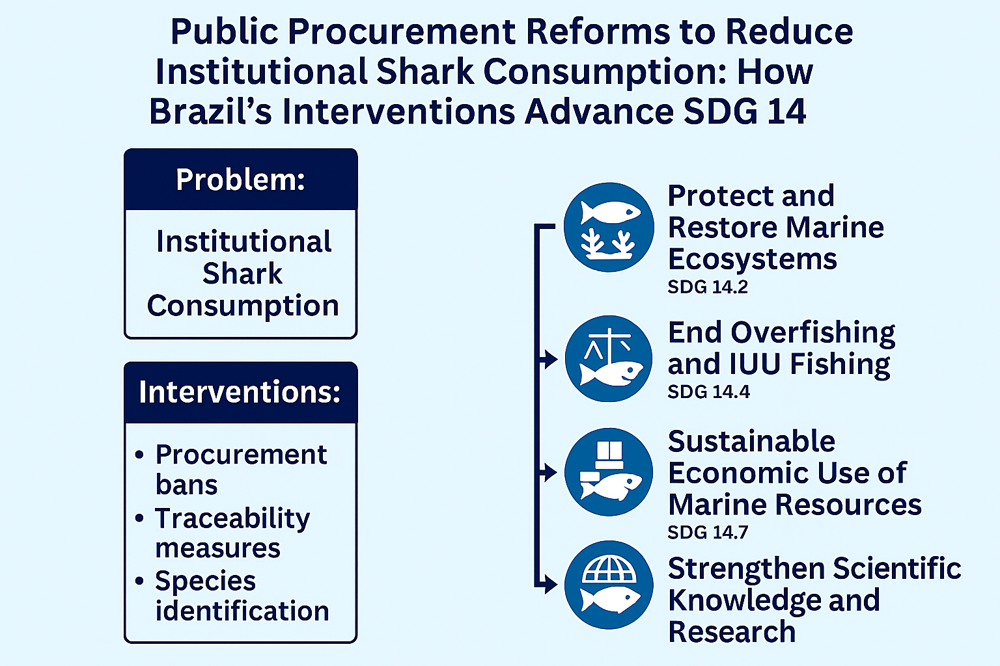
Brazil’s procurement reforms, regulatory tightening, and bans on shark meat directly advance several key targets under SDG 14: Life Below Water. Below is a mapping between Brazil’s case and specific SDG 14 targets impacted.
SDG 14.2 — Protect and Restore Marine and Coastal Ecosystems
This target calls for protection and sustainable management of marine ecosystems to avoid adverse impacts and support ecosystem resilience.
Brazil’s removal of shark meat from public procurment, including schools, prisons, hospitals, and municipal food programs, significantly reduces domestic demand for species already under heavy fishing pressure. By weakening one of the most stable market channels for shark meat, these procurement bans support the recovery of shark populations and strengthen the ecological stability of coastal ecosystems.
SDG 14.4 — End Overfishing and Illegal, Unreported, and Unregulated (IUU) Fishing
This target aims to regulate harvesting and eliminate overfishing and IUU fishing through science-based management.
Brazil’s case directly contributes to this target through measures that increase transparency in shark supply chains. The federal court ruling requiring species identification and traceability in all federal public procurement disrupts the long‑standing practice of masking shark meat under the generic term cação. This transparency makes it far harder for illegally caught or misreported shark meat to enter institutional kitchens. In parallel, export regulations, including fins-attached rules, prohibitions on wire leaders, and mandatory release of females and juveniles, further constrain destructive and unregulated fishing practices.
SDG 14.7 — Sustainable Economic Use of Marine Resources
This target encourages the development of economic models that rely on sustainable marine resource use rather than depletion.
For years, public procurement financially sustained the shark trade. A Mongabay investigation revealed 1,012 public tenders procuring over 5,400 metric tons of shark meat across 10 states from 2004 to 2025, a massive economic pillar supporting continued extraction. By eliminating shark meat from procurement contracts, Brazil redirects large public budgets toward sustainable alternatives. This deprives the shark trade of one of its most predictable sources of revenue, encouraging a shift toward sustainable fisheries.
SDG 14.8 — Strengthen Scientific Knowledge and Research Capacity
This target focuses on improving ocean-related scientific research, monitoring, and data systems.
Brazil’s reforms strongly reinforce this goal. Traceability obligations within public procurement and export controls require species identification, contaminant testing, and full supply-chain documentation. These measures expand Brazil’s data capacity, generating reliable information on shark species being caught, traded, and consumed.
We use cookies to improve user experience. Choose what cookie categories you allow us to use. You can read more
about our Cookie Policy by clicking on Cookie Policy below.
These cookies enable strictly necessary cookies for security, language support and verification of identity.
These cookies can’t be disabled.
These cookies collect data to remember choices users make to improve and give a better
user experience. Disabling can cause some parts of the site to not work properly.
These cookies help us to understand how visitors interact with our website, help us measure and analyze traffic to improve our service.
These cookies help us to better deliver marketing content and customized ads.